
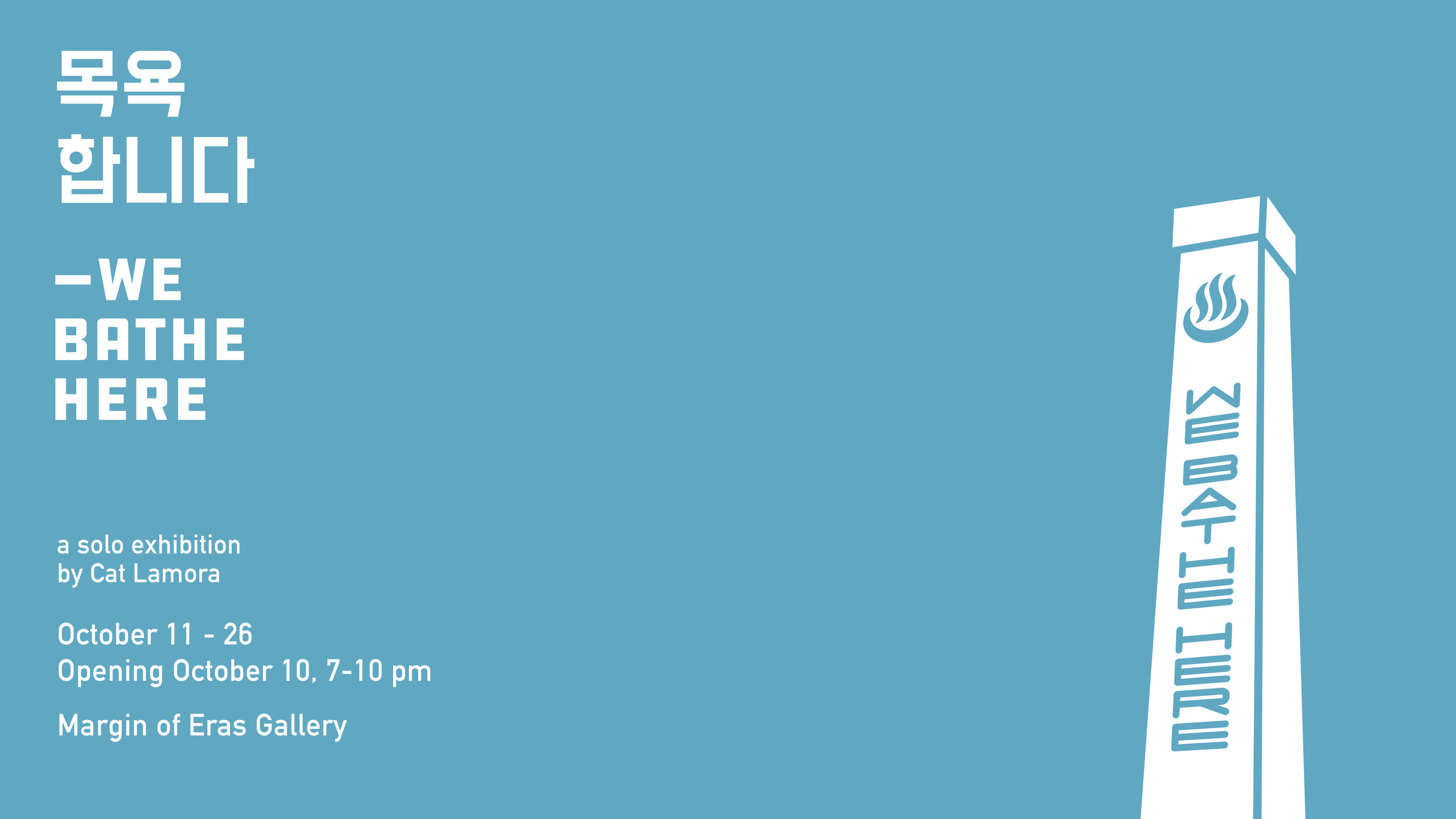
I was recently approached to help support and give photographic context to the latest art project and installation by Cat Lamora, an incredible Korean-Canadian paper artist based in Toronto, Canada. The installation, We Bathe Here, explores themes of connection within a shared and very vulnerable space, specifically the public bathhouses in Korea.
Prior to Cat contacting me to contribute to her project, I had come across a photo book entitled 서울의 목욕탕 by 6699 Press in a waterside cafe in east Busan that focused documented the public bathhouses in Seoul. Since then, I always thought about taking a few photos and documenting the 목욕탕 / public bath I went to on a weekly basis simply for the fact that there is nothing to compare it to where I am from in America. I was always a bit hesitant to bring my camera due to the nature of the environment and my inability to effectively communicate to the patrons or owners of such places as to why I would want to photograph such a vulnerable and private space.
While the baths themselves have a history and purpose of their own, I personally find them to be a place to let go of the stress of the week. For me, it’s a place to rest and reset and let the sounds of water bounce off the tiled floors and walls, immersing me in a place where I am taken away from what’s outside. While most of the time I enjoy the quiet time, I also appreciate the friendly Korean men who strike up small conversations and let me practice my Korean speaking with them.
The best parts about contributing to Cat’s latest work was not only making photographs of a unique and intimate space, but also reflecting on my own personal experiences in that space and what it has meant to me. As an added bonus, my photographs were also presented alongside the photographs from the same book I found and had flipped through months before. From start to finish, this has been a great converging of events, experiences, and talented people; and I thank Cat for letting me be a part of an authentic piece of work that shares her vision as an artist and identity as a person. Needless to say, if you are in the Toronto area, go check it out.
You can see a video providing further context, my contributions to the work, additional artist information, and exhibition information below:
“We Bathe Here” Preview, a solo exhibition by Cat Lamora from Margin of Eras Gallery on Vimeo.


We Bathe Here
Excerpt from Partners In Art:
We Bathe Here is an immersive paper installation that explores themes of connection within a shared and very vulnerable space. The installation aims to interpret the transition where a long-used space becomes a physical, emotional, and cultural reflection of its people and how these spaces also influence the internal strata of experiences – both personal and cultural – within the people.
Cat Lamora is a Korean-Canadian paper artist based in Toronto. Since immigrating to Toronto, she has exhibited her work in Toronto, Vancouver, and Berlin, including exhibitions at the Northern Contemporary Gallery, Xpace, CBC Centre, Annex Art Center, Creative Pulse, and the Jarvis Dooney Gallery.
The installation will reproduce, through Lamora’s three-dimensional paper art, a realistically scaled environment of a Korean public bath, complete with water wells, a large pool, wash stations/showers, skin scrubbing stations, along with seating, and traditional tiles throughout the 1300 square-foot space. The exhibition will also feature soundscapes of running/dripping water combined with a cacophony of distant, echoed, voices, along with a video piece that will be projected onto the ceiling intended to act as a reflection of water. This exhibition will transform the MOEG into a Korean public bath, but made entirely from paper. The entire physical installation will be composed of paper, with cardboard and Styrofoam structural supports, created by the artist Cat Lamora.
Naked, vulnerable, people gather together to silently pour out a river of emotions within the ritual of bathing. These stories are not lost but instead are written in steam and water, invisible engravings on the tiles themselves. The Korean public bath is a physical manifestation and reminder of peoples’ stories, a place of ritual where one’s belonging is unquestioned.
Exhibition Information









 dylan barnes | blog