Tag: film photography

  • Reader Excerpts: Forty Eight Hours in Tennessee

    Reader Excerpts: Forty Eight Hours in Tennessee

    Today’s piece comes from Ryan Berger. Ryan tells us about his humble beginning in photography; fast forwarding through his digital cameras, our friendship that has been cemented through photography, and his new-found love for his Fuji GA645zi that breathes new life into his creative expression and hobby to record his daily life.

    Reader Excerpts allow those who read Now Developing to become part of the collective by sharing a written piece alongside their images on a topic of their choice.  If you are working on a project, would like to display some of your work, explain your creative process, or have any other prospective ideas for a personal perspective piece and would like to have it featured here, feel free to contact me!

    Forty Eight Hours in Tennessee, Written by Ryan Berger (Blog, Instagram)

    Forty Eight Hours in Tennessee

    I remember my grandmother’s love of disposable cameras. Growing up, every trip we went on, we packed a 10 pack of those cameras so my grandmother could snap away and gather the memories that defined our family vacations. I thought it was silly at the time, and always got a kick out of the developed images – 80% of them including her thumb in the corner of the frame. She’d always throw me a few, and I would take pictures and then always be excited to see how they turned out as we waited to get the developed film and prints back from Walgreens.

    Looking back now, even as imperfect as those images are, they’re super meaningful and they make me remember things that I’d otherwise forget. It’s not that the photos are anything special (Sorry, Grandma, but those cameras are really terrible), but they’re real. Capturing the everyday moments that otherwise get filtered out by the constant fire-fighting we do in our lives. I never really thought about it until I sit down to write this up, but without a doubt, her style of photography, inspired me. A simple goal: to try and capture my life through a lens: my everyday life.

    I remember asking my mom for a digital camera when I was 14. We were getting ready to move to a new town and I wanted a hobby other than video games. She got me a Canon PowerShot ELPH, a very simple digital point and shoot. Honestly, I think it was 3 megapixels. I loved that camera, it went everywhere with me and I took pictures of everything. This continued on until I got to the point where I felt like I wanted to pursue photography more seriously and move into shooting with a DSLR. For my 18th birthday, I ended up with a Nikon D40, and the kit. I met Dylan about 10 years ago, through our current admiration for edgy streetwear brands and photography alike. Still shooting with the D40, but using a 35mm prime lens. We both lived in the same town where it was hard to make friends, even harder to make ones that shared similar interests. We grew up together, taking photos. The cameras we shot with changed, but we always took pictures. I stuck with digital, moving to a full frame system to shoot some menswear-fashion work for a blog I was running at the time. As the commissioned work kept coming in, I got more and more tired and burnt out of taking photos for personal enjoyment.

    After starting to feel myself lose interest in photography, I decided to switch back to a pocketable point and shoot, a Ricoh GR digital. This camera brought my heart back into photography, and made me want to go out and just walk around the city and take pictures of whatever caught my eye.

    Me and Dylan got an idea to show some work at a coffee shop in our city, and it was a huge success. Everything I showed was from this tiny camera that was always in my pocket. I loved the idea of that. That I could make images that people enjoyed from a camera like the GR. It was simple. Just a 28mm 2.8 lens, no fancy glass or interchangeable lenses needed.

    After three years of shooting with the Ricoh, and seeing my work alongside Dylan’s, I could always see the difference of medium format, the unexplainable depth that the photos had, compared to a digital sensor. Ever since Dylan had made the switch to just film, I was always inspired by the process and the end result as well. Finally, I showed an interest in trying out a film camera and after a pretty quick conversation, decided on a Fujifilm GA645zi. It was the perfect gateway from digital to film that fit my shooting style: a medium format camera, but still a simplistic enough for my personal shooting style.

    Quickly going through a roll of film the day the camera arrived from across the pond from Japan, I was anxious to see the results. Without a doubt, I knew there would be a learning curve. No on-screen focus confirmation, no 7-shot burst on the same subject, and most importantly — no instant gratification. Just a quick look to see if my lens cap was off, and the hope that I focused on the right distance. It was weird not being able to get home, move over 30 photos, pick 10 of them, edit, and post them to Instagram right away. I liked that feeling though, I had to slow down and really think about the things I took pictures of and how I composed the shot. This camera made me be careful with photography, but in the best way. It’s quirky, and I’m still learning to embrace those quirks, but I’m stoked.

    Getting back that first roll, despite forgetting to take the lens cap off for a few photos, was such an amazing feeling. I always take photos to remember a feeling I’m having, so that whenever I look at that, I can go back and remember why I took it to begin with. This hasn’t changed in my transition to film, but the internal result for me was amplified by seeing my photos in a new format and essentially a new medium all together.

    I don’t know all of the film lingo, as this is all extremely new to me, but the tones that came through just blew me away. Gradient coloring like I’d never seen in my digital photos, and image depth that I think surpasses a full frame sensor in its own right. I was sold, so sold that I told myself I should just shoot film for a few months and learn this new world inside and out.

    Shortly after those first two rolls, I had a quick weekend trip to Nashville upcoming. Camping in the mountains with my girlfriend, and then just spending a day in the city. With the decision already made to just shoot film for a while, I stocked up on some Portra 400 and Ektar 100, crossing my fingers that I wouldn’t take a bunch of blurry, improperly exposed, or out of focus photos.

    Out of the 4 rolls I shot, I took 3 photos with the lens cap on, 13 photos that were either blurry or underexposed, and 48 usable photos. Out of those usable photos, I loved all of them. Unlike my easy to throwaway digital photos, to me, these were all great photos, even with their imperfections. Whenever I look at them, I’m taken back to how I felt the second the shutter clicked. From taking the photos, having them developed, scanning them in, and then proofing them, it was just a really great feeling to see the images come to life. I’m excited to continue down this road, learn as I go, and hopefully make some really rad photos in the process.

    All photos were taken using a Fuji GA645zi on Portra 400
  • Reader Excerpts: Somewhere Between Waking and Sleeping

    Reader Excerpts: Somewhere Between Waking and Sleeping

    Today’s visual-narrative piece comes from Michael Ivnitsky. Michael shares a project entitled “Somewhere Between Waking and Sleeping.” A documentary of his time while transitioning back to life in Tel Aviv explores and visualizes his struggles with insomnia and the constant battle to keep the wheels beneath him moving while transitioning between the dynamics of two very different cities.  

    Reader Excerpts allow those who read Now Developing to become part of the collective by sharing a written piece alongside their images on a topic of their choice.  If you have any ideas for a piece and would like to have it featured here, feel free to contact me!

    Somewhere Between Waking and Sleeping, shot and written by Michael Ivnitsky (Website, Instagram, Blog)

    This project was birthed upon my return to Tel Aviv after living in Dublin for 18 months. I moved to Dublin for a while after growing tired and emotionally drained of Israel.

    Tel Aviv is an intense and polarizing place, especially after the sleepy and polite city of Dublin.  While in Dublin, the first six months were filled with insomnia, visiting old friends and meeting new people, finding old places I liked (closed or worse, changed), and being dragged to places I don’t know.  Generally this consisted of trying to get accustomed to the killer pace of working hard whilst partying harder with an occasional visit to an island for serenity.

    This majority of this project was shot with a Leica M4 and 35mm Summicron f/2 on Foma Creative 200, developed in D-76 1+1 for 9min @ 20c.  Other shots were taken using a Nikon EM with a 50mm f/1.8 E.

  • Camera Review: Minolta AF-C

    Camera Review: Minolta AF-C

    With premium point and shoots skyrocketing in price due to their scarcity, celebrity endorsement, and cool-guy factor, many people are searching for alternatives to cameras such as the Contax T2 (nearing $600, I sold mine for $325 about a year ago) and the also steadily-rising Olympus Stylus Epic with 35mm 2.8 lens (some asking prices near $2-300, but I have found more than a handful at the local Goodwill for under $4).

    I frequently (almost daily) come across Facebook groups where someone is asking about the best quality point and shoot for the best price.  Typically speaking, OP is looking for a camera with a sharp f/2.8 lens.  In the replies, I always see the same answers; the Contax T2, Olympus Stylus Epic, Rollei 35, and Olympus XA usually round out the top of the responses.

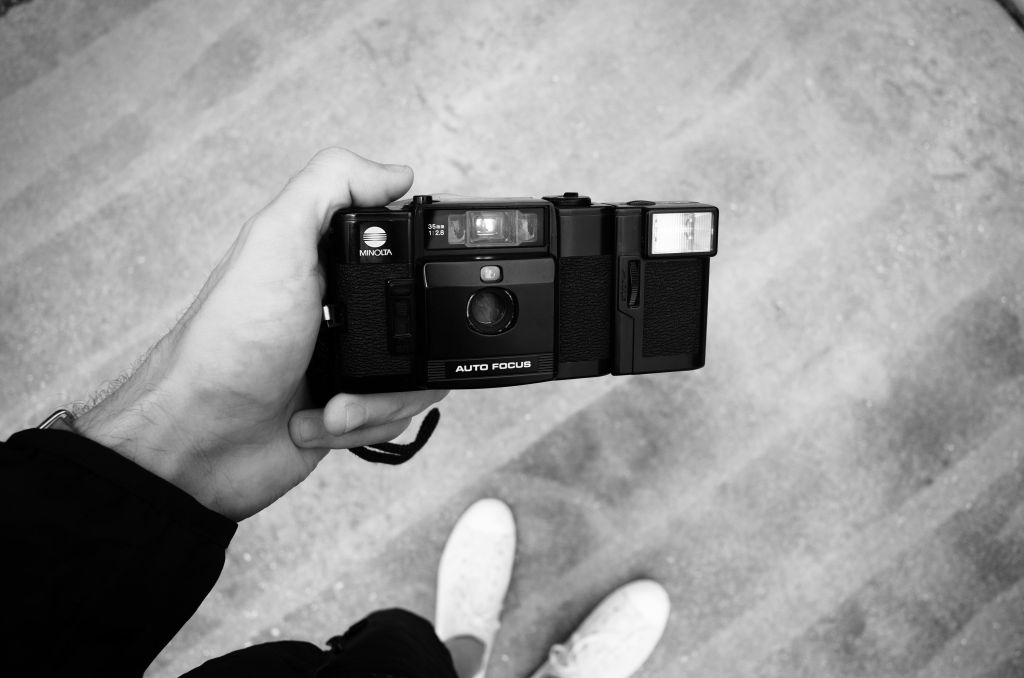
    One camera that I have never seen mentioned (nor did I know it even existed until recently) is the Minolta AF-C: something that looks like the long lost sibling of the Olympus XA series or the Lomo LC-A.

    The Minolta AF-C is an interesting camera.  By its looks, it appears as if the Lomo LC-A and the Olympus XA had a love child.  The AF-C has a sliding lens cover and also sports a detachable side-mounted flash.  It’s pretty slick looking, perhaps a bit too Robocop-looking for me personally, but it does remind me a bit of an 80’s Ferarri.

    Starting at the top of the camera, the camera is ridiculously simple and minimalistic for better or worse depending on what you are looking for in a camera of this type.  The camera only has a rewind knob, shutter button, and film counter on top.  The film advance is also manual.  To me, this makes the camera feel a little cheap.  It makes me long for the advance tab seen on my Minox 35 EL.  The front of the camera is just as simple.  The AF-C sports a 35mm f/2.8 lens with a self timer switch to the left and an ASA dial underneath the sliding lens cover.  The left side of the camera (looking at the front of the camera) has a small metal loop for a wrist strap while the right side of the camera has a connection for the EF-C flash which looks strikingly similar to the Olympus A11 flash.  Finally, the bottom of the camera has tripod accessibility as well as a battery door and film rewind release.

    Loading film into the Minolta is probably my favorite part about the camera.  The take up spool has such a neat little mechanism that grabs the film tab as you load and advance the film through for loading.  Be careful on used/abused cameras, because sometimes this tension clip loosens over time.  My initial roll was compromised because I trusted that the clip was in working order.

    When taking photos, the viewfinder is relatively bright.  It has two LED lights at the bottom. A green LED to indicate successful autofocus and a red LED to indicate a low light exposure.

    The camera is rather pocketable with the flash on, but much more so without it.  Personally, I do not utilize a flash all that often, so I would probably leave the flash at home anyhow.  I know we are talking about ounces here, but when it comes to portability every centimeter and ounce tend to count.

    Shooting the camera is just as simple and as easy as it looks.  Point, press half way down to be sure of exposure and focus, and slam it down for the shot.  The lens is super sharp, and I consider it (and the camera) all too overlooked.  Perhaps this will change as the popularity of point and shoots is on the rise and consumers searching for an affordable and quality camera will start breaking off from the soon to be unattainable Contax-branded cameras.  The only downside I can mention is that you really have to trust the camera.  It’s reliable, but some shooters really value their manual controls. Oh, that and ISO 400 is the highest setting on the camera.  So, you have to adjust accordingly.

    In the test shots below, I include both black and white and color film.  The roll of Fuji Superia 400 I shot was a bit dated and wasn’t stored very well.  It came out a bit underexposed, to say the least.  You can still see the quality of the lens through the fade and haze of the expired film, but perhaps not a great representation of color and exposure.  These aspects are seen best in the black and white frames provided.  Those were shot by my buddy who I borrowed the camera from for the review.

    All in all, the camera is solid for the purpose it’s meant to serve: to point and to shoot.  It’s quick and produces quality results.  It’s pocketable, and rather inconspicuous.  It also performs rather well in all general conditions, which is nice for a camera you want to have on you at all times.  However, if you’re looking for any manual control aside from setting the ISO, you might not enjoy it as much.

    Minolta AF-C // Superia 400
    Minolta AF-C // Ilford HP5+
    Minolta AF-C // Tri X
    Minolta AF-C // Superia 400
    Minolta AF-C // Tri X
    Minolta AF-C // Superia 400
    Minolta AF-C // Tri X
    Minolta AF-C // Superia 400 // No Flash v. Flash Comparison
  • Now Developing on Analog Talk Podcast

    Now Developing on Analog Talk Podcast

    Last week, I got to sit down and talk with Christine and Timothy of the Analog Talk Podcast to talk about film photography (obviously), teaching and passing on the craft to the children, using a darkroom, and scanning your negatives. I hope you enjoy listening us nerdtalk as much as I enjoyed hanging out with these two awesome people!

    The episode can be heard below:

    https://analogtalk.podbean.com/e/now-developing-with-dylan-barnes/


  • Ongoing Process: One Year Later

    Ongoing Process: One Year Later

    One year ago today, I started Now Developing.  I can’t say for sure that everything I accomplished over the past year revolved around this blog, but I can definitely say that a good chunk of my experiences regarding photography over the past year in some shape or form definitely was either directly or indirectly due to the work or motivation that stemmed from this project.

    In my very first post, I stated that this was something that was going to reinvigorate my creative spirit; and that my mind was starting to overflow with ideas of what the blog could be, become, and contain.  What I don’t think I anticipated was how putting my reflective journey through written discourse and capturing images up to the public of the internet could open up various windows of opportunity, amplify my desire to continue to create, and connect me with so many rad people across the globe.

    Before I jump into the things I am most happy about from the past year, I would like to take a moment to just list out some of the objective data the website has amassed in just 365 days:

    • 42 Published Posts
    • 6,866 Views
    • 4,559 Visitors

    I remember when the blog reach 1,000 hits.  I was ecstatic.  Needless to say, I am extremely honored that at the end of one year the numbers are what they are.  It’s just so…neat.  I know that in the grand scheme of internet traffic, I’m not pulling in millions of hits, nor am I making any monetary gain with this venture.  However, that was never the point.  As the blurb on my About & Contact page says:

    I made this blog in order to record my thoughts, learning, experiences, and reflections as I continue to shoot film and develop images by hand.  In a sense, the images I create and share are a literal and figurative reflection of who I am and who I continue to become.

    But this has been anything but a solo venture.  As I stated earlier, I have come in contact with some pretty amazing people.  People that I believe have now become a part of the Now Developing narrative that I respect, admire, and call friends.  Their support and the inspiration that they impart on me cannot be appreciated enough.  From simple chats, to camera talk, to mailed packages, to making my blog’s logo, it is all appreciated the same at a heartfelt level.  To avoid the risk of forgetting some integral people, I would simply like to say you know who you are and I thank you endlessly.  My gratitude cannot be truly verbalized.

    I have accomplished quite a bit over the past year, and I can truly say that I am proud of the work I have done.  Again, I don’t think I can say I did any of this without the help of others.  I think creating goals is important, however, I think it is just as important to recognize when you achieve them.  So, without sounding too overzealous, I would simply like to list out the things I found noteworthy from the past year:

    • Self published my first book under the Now Developing imprint, twenty seven, twenty eight
    • Started printing work digitally
    • Built a darkroom for me and my students to start enlarging our negatives
    • Working with the Film Photography Project continuously to provide a better photographic education for my students
    • Partnering with Shoot Film Co. to put some really cool things into the hands of my students to assist them in securing their identities as film photographers
    • Able to be a part of the greater artist community in the Tampa Area, participating in displaying works at three different local locations
    • Held two exhibitions outside of the US, both taking place in South Korea
    • Traveled to Japan, and subsequently got to meet, hang out, and share a cup of tea with Bellamy, Japan Camera Hunter
    • Featured on Japan Camera Hunter, highlighting how shooting photos helped me cope with the loss of my father
    • Was interviewed on Analog Talk Podcast about photography as a hobby and passion
    • Provided a platform for other self-developing photographers to share their stories, featuring ten photographers thus far

    While this list fills me with a large sense accomplishment, it is not without a secondary list; a list of goals for the upcoming year to strive for:

    • Host a solo photographic exhibition
    • Host a collective art exhibition
    • Publish two more publications of my own highlighting my time Korea and Japan
    • Publish a collective zine for the Part of the Process featurettes
    • Attempt a Now Developing Youtube channel
    • Travel to meet, shoot, and collaborate with people I have met over the past year
    • Recruit others to share their experiences through contributions on Now Developing

    Overall, I couldn’t be happier just 365 days from my decision to start this blog.  In this past year alone, I truly think I have made my best photographic work to date.

    I’m elated, to put it simple.  I am filled with ambition and motivation to not only shoot more, but to share more.  To share both my images and my experiences as someone who records individual moments of time.  As always though, the process continues.  To me, nothing is ever quite perfect,  both in my work and through the course of self-actualization.  As cliche as it sounds, it’s not about the result, it’s always about the process.  If you’re willing to take a risk, there’s always a chance for an equal reward.  I feel lucky enough to have obtained that reward.

    Whether you’ve read something here, given feedback, provided content, given me motivation, inspired me, or interacted with me in anyway because of this page, I just want to say thank you.