Tag: film developing

  • Why You Should Leave the Light Meter at Home (At Least Once)

    Why You Should Leave the Light Meter at Home (At Least Once)

    Why You Should Leave the Light Meter at Home (At Least Once)

    When I first started shooting film, I toyed around with some auto-exposure point and shoots (I think I still have that Canon SureShot 35AF somewhere) that I picked up from a local thrift store.  I simply just wanted to give film a try.  As I quickly researched and progressed through different 35mm cameras, I finally mustered up the courage (with plenty of pressure from a friend of mine) to purchase my first medium format camera.  Not only did I not know how to load my new-to-me Mamiya 645 Pro TL with a non-metered prism, but this would also be the first time that every step of the photographic process would become a more manual experience.

    Mamiya 645 Pro TL w/ 80mm // Kodak Portra 400

    I had never used a light meter, loaded a roll of 120 film, nor had I ever really forced myself to manually focus prior to the purchase of that camera.  At that time, I remember being so afraid to learn how to work a light meter.  For some reason, that device was just intimidating, not worth the expense (neither was the metered prism), or too cumbersome to carry for whatever reason.  After a quick search or two, I found a few mobile light meter apps that seemed to be much more inviting and user friendly until I could muster up the bravery to try a real light meter.  Something about the older ones with all of the numbers really frightened me for some reason.  Knowing what I know now, of course a dedicated light meter performs much better than your cell phone, but at the time, it did the job in letting me get the shots that I wanted and enabled my dependence on using something to evaluate the light in a scene.

    The photos I got with my Mamiya are still some of my absolutely favorite photos I have ever shot.  Not only do I love the shots I took with that camera, but there was something about that learning experience that make those pictures a bit more sweeter and more meaningful.

    Mamiya 645 Pro TL w/ 80mm // Kodak Portra 400

    Over the course of the next few years, I bought, sold, and traded a bunch of different kinds of cameras.  Almost every single camera that I wanted to try or get my hands on, it was sort of required that it would have a built in meter.  While I still tried cameras like the Pentax 67 and Hasselblad 500c, I felt that it was more of a chore to shoot these cameras simply because I had to take a light reading out of camera.  And due to my continuous use of a built in meter, I also felt that I would need to meter the scene every single time I decided to take a photo.  I know that isn’t totally necessary now, but everyone’s habits are different.

    Hasselblad 500c w/ 80mm // Ilford HP5

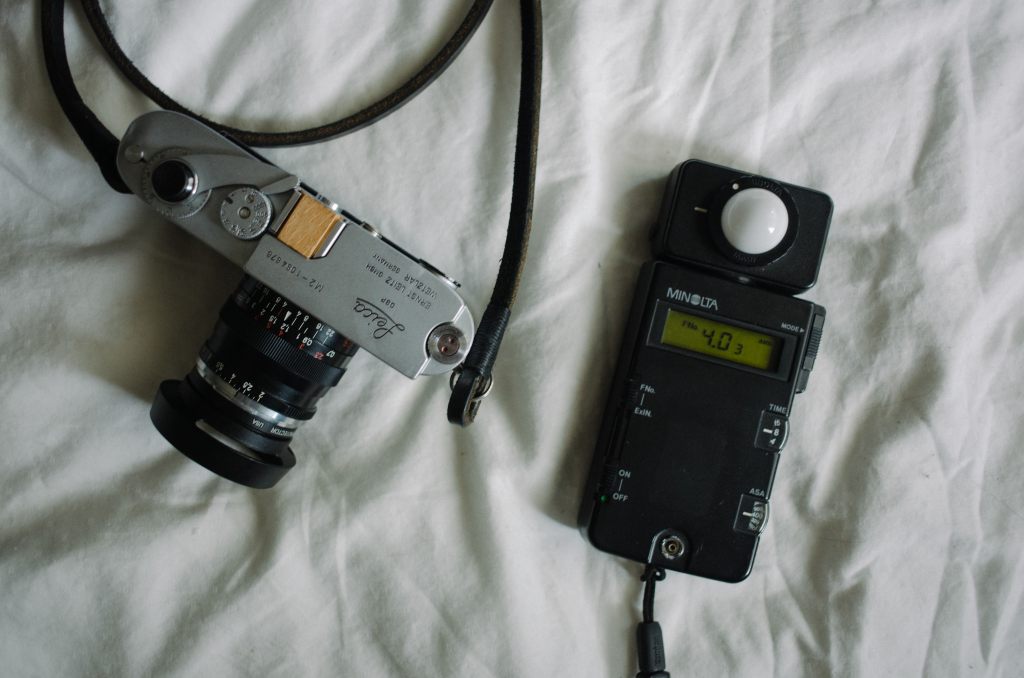
    Fast forward to a couple of weeks ago, I had a chance to get my hands on a Leica M2.  After experimenting with other M-mount bodies like the Konica Hexar RF and Leica CL, I just still didn’t understand the mystique behind the Leica name.  Meanwhile, I am still stuck here lusting after an MP.  But, I figured I would give the M2 a fair attempt with the understanding that I would definitely purchase Voigtländer VC ii meter when I found one for a reasonable price.  Turns out, the VC meter is pretty sought out after, maintains its value on the used market, and people don’t like splitting the meter from the body it’s on to sell separately.  And understandably so.

    With that, I decided to purchase a Minolta light meter for less than $40.  I used it once on the day I got it, and haven’t really touched it since.  Again, I found it to be a bit troublesome to carry around this extra piece of extraneous equipment simply to take a single light reading on a day or shooting.  At a time where I am trying to simplify many things, including the number of cameras and lenses I have on the shelf to choose from, I decided to leave the meter at home from that day on.  I decided to simply use my instincts and all of those basic rules we learn when we first start shooting photos (f/8 and be there, Sunny 16, and so on).  If I really needed to use a meter, I can always pull out my trusty meter app that served me well enough in the past on more than a handful of occasions.

    Yashica A // Kodak Porta 400

    While I have only put a few rolls through my M2 since receiving it, foregoing the meter and trusting my instincts has been a liberating experience.  So far, I have only shot three rolls of rather-forgiving 400-speed Ilford films and a single roll of Kodak ColorPlus 200, but I can happily say that I have yet to waste a single frame from absolutely botching a light estimation in my scene.

    Leica M2 w/ 35mm Zeiss ZM // Ilford HP5

    Sure, I may have missed by as much as a couple of stops, but nothing has been rendered unusable or unfixable with some minor corrections if necessary.  Even when doing a few prints in the darkroom, not much has been lost.  I’ve pushed and tested myself in a variety of environments simply by using the Sunny 16 rule and adapting it to whatever environment I find myself in; whether that be an indoor sporting event, night shooting, or in direct or indirect sunlight.

    I have found that shooting without a meter has been quite a liberating and confidence-boosting experience.  After depending on something for so long and just going without it was a bit uneasy, it was a great way to put my skills to the test.  When it comes to shooting without a meter, I probably wouldn’t say that it’s one less thing to worry about.  If anything, I probably worry about it even more.  As each roll is developed, I and initially nervous and anxious to see if there will be photos throughout the roll, but in turn I have become more and more comfortable in foregoing a meter.  I’m not saying that I’ll go meter-less from now on or even go shoot a somewhat important event without one, but it makes the simple reward of seeing my images that much sweeter.

    Leica M2 w/ Canon 50mm LTM // Kodak Color Plus 200

    If you have been shooting for a bit now, but have yet to go without a meter, then I urge you to just give it a shot.  Perhaps you’ve been looking for a new challenge, or simply want to alter your shooting experience just a bit to break from your normal routine for something slightly new and different.  Perhaps you are like I was; scared to remove that safety net in favor of verified, perfectly exposed shots, every single time.  If that’s the case, then I say it may be time to give yourself some room to make a mistake and simply test yourself.  Give up a little control in exchange for a little bit of uncertainty and excitement.  It makes the process that much more rewarding in the end and chances are that you are way better at this than you think.

  • Developed Roll: Leica M2 w/ 35mm Zeiss ZM // Ilford XP2 Super 400

    Developed Roll: Leica M2 w/ 35mm Zeiss ZM // Ilford XP2 Super 400

    All shots were taken with a Leica M2 with 35mm f2.8 Zeiss ZM.

  • Student Showcase: Club Photos 2017

    Student Showcase: Club Photos 2017

    It’s that time of year again.  As we approach the Holiday season, me and my middle school film photography students begin to prepare for the annual gallery event.  This year has been especially rad because we were able to put together a darkroom and begin enlarging our negatives in addition to scanning them.

    In the past, newer, younger students were handed point and shoot cameras to focus on shot composition and film familiarity.  However. these young preteens and teenagers have seriously risen to the occasion this year since I took all training wheels off by handing them an SLR on day one.  The results were nothing short of amazing.  I find it particularly interesting to flip through my students’ images simply because of the subjects they choose to shoot.  Theoretically, it’s probably just like any of us; simply shooting the things that we care most about and find interesting.  However what a 11-14 year old finds interesting is much different. Their worlds are typically much smaller than ours and they find a lot of beauty through the that narrow scope, although each of our individual journeys are much different.

    I plan on doing a post later on in the coming weeks on the final results of their work along with the gallery event, but since the students have a solid catalog of images already scanned in, I figured it would be a great time to display some of my personal favorites from the student archive of 2017.  I hope you enjoy the images as much as I enjoyed teaching the film experience to another group of youngsters.

    Zoe B.
    Joey M.
    Anthony B.
    Kyleigh O.
    Elizabeth B.
    Cole G.
    Morgan C.
    Abbigail J.
    Emma D.
    Emerlina L.
    Anthony L.
    Brianna L.
    Olivia T.
    Haley M.
    Talia W.
    Jailyn N.
    Mackenzie M.
    Janelle R.
  • Part of the Process: Eric Löfgen

    Part of the Process: Eric Löfgen

    Part of the Process is a series of posts that puts the spotlight on film photographers and DIY film developers.  These features provide unique experiences and perspectives on shooting and developing film while also showcasing diverse talent and film photographers around the globe.  If you are interested in being featured, feel free to contact me!

    Name: Eric Löfgen

    Location: St. Vith, Belgium

    Links:

    Flickr

    Instagram

    What other websites or blogs do you keep up with to feed your photographic interests?

    Petapixel, Lomography, ishootfilm, and Matt Day on Youtube.

    What attracted you to film photography? How did you get started/introduced to shooting film? How soon after did you start developing?

    I never really was interested in photography, I was more into music during my youth. Sometimes, my best friend took his camera to our rehearsals and he shot some pictures of us. What I really liked about that, was that two months later he showed us the shots. I was used to that when I was a kid because of my parents, but seeing this years later fascinated me.

    A few months later, I contacted another friend who was into photography, to give me a quick lesson about exposure and all that. He gave me his Pentax and I took some shots. After that it took me almost a year until I purchased my first own 35mm camera. It was a Yashica MG1 that I found at the flea market. I still had some troubles shooting because the exposure was fixed to around 1/60s and I didn’t like rangefinders at the time.

    Another two or three months later, an old friend contacted me. His grandfather died and they found his old photo gear in the attic. It was a Canon AE-1 with a 50mm, a 28mm and a 80-200mm. I immediately bought it and I’ve never regretted that decision. I started shooting more and more, mostly landscapes.

    But I was still learning, I shot a few rolls who were completely underexposed. I wanted it too fast — so I started to teach myself more about exposures and ISO. After that, I was in a buying rush, everything I saw on flea markets had to be mine. I got into developing at home, because my local development spot charged me about 24€/roll, which was really expensive because I was shooting a lot more by this time.

    I started with a Adonal black and white starter set. The next evening, I developed my first roll. The pictures were bad, but the feeling while pulling the film out of the spool was unmatched. Seeing that I nailed it was a great feeling. Half a year after that I started with C41-color development.

    What do you like to shoot on a regular basis?

    I mostly shoot portraits at the moment. To me, portraits are the best way to capture feelings.

    What formats, cameras, and films do you shoot? What do you like about the formats, cameras, films you prefer? 

    I’m shooting a few 35mm cameras: Canon A1 & AE1 and a Rollei 35s.  I use my 35mm for action shots like concerts and skateboarding. They allow to jump in and take the shot because they are a bit more handy. They are more of  a snapshot camera to me, if needed.

    For medium format, I am using a Yashica Mat 124.  I’ve been forcing myself to shoot only with my Yashica Mat 124 this past summer, to learn more about the camera and to slow down a bit more. I’m using this camera mostly for portraits and landscapes. It allows me to think about what I am about to shoot.

    I am also shooting Polaroids using a Polaroid EE66.  My polaroid camera is just for fun. It is mostly used on evenings combined with drinking with friends.

    I’m still looking for my favorite film, but I am currently shooting Kodak Portra series, Ilford HP5, Ilford Delta 400, and Fuji-100.

    What types of film do you develop?

    C41 and black and white.

    Tell us about your first experiences in developing your own film.  How did you muster the courage to give it a shot? What resources did you use?

    I remember my first roll quite well. It was a 120 roll of Ilford FP+. It was actually kind of a risk. I never did the spooling with a medium format film and I wanted to try this the first time in complete darkness. It took me half an hour until I got the film into the spool and at the end, I wasn’t even sure if it was right. During this half hour I thought “What the fuck? Why am I even doing this? This is nuts! You won’t succeed!”. When I turned the light on, I proved myself correct because I mistook the backing paper for the negative. Beginner fail.

    I did some research on the internet and everyone was saying something different. I read many blogs, watched many youtube videos. To be honest, I did not expect any results. So many ways, and so many different times to develop film.  I just didn’t know where to start. But when I opened the tank and I saw something, I realized that I did it. I developed my first roll of film!

    What is your development process like now?

    At first, I’m shooting some rolls until I have enough film in my fridge. After that I start developing. When everything is dry, I start scanning. Mostly with a good beer, because it takes forever. After scanning I’m archiving the rolls.

    What’s your processes regarding scanning, enlarging, and/or printing your work?

    I scan all film myself with a Canon 9000F Mark II. Not the best scanner in the game, but it’s alright. I’ve bought an enlarger on eBay, did some prints but I didn’t find the time yet to really get into it.

    Sometimes I’m developing with friends. These evenings are special to me. We’re both creating something this evening. Drinking a beer during and talk about life. This is something unique that I really enjoy about my process.

    What equipment are you using to develop your film and why?

    I’m using the paterson beginner set with Paterson 35mm and medium format tank with Adonal black and white chemicals. I’m using the Tetenal C41 for color. I did not choose a special brand, the monetary offer just was simply attractive to me.

    Are you content with where you are now with your shooting and developing? Do you have any future plans or ambitions?

    I’m still looking for my way in this world. I’m currently trying to improve my development process. I’m also trying to shoot more with models/people I don’t know. That’s something I’m afraid of but I’m ready to try something new. I always learn by doing, so that’s something I have to do.

    Have you completed any notable projects or in the process of creating something from the film you have shot and developed? 

    I just started my first project called a summer on 6×6. The concept is very simple. I shoot my Yashica Mat124 all summer and develop them come Autumn. Maybe I’ll do some prints, or maybe even a book. We’ll see. I have some other projects planned for the coming years.

    What advice can you give to others who are interested in shooting and developing film but are apprehensive about getting started?

    Try it and don’t be afraid of failing! Failing is normal but you’ll learn from it! You will love it.  Take notes, get into you own rhythm, never stop learning, watch youtube videos, try different techniques … Don’t let anyone stress you. Shooting is my way of relaxing. It allows me to slow down in this stressful world 🙂

  • Shutter Sounds: 003

    Shutter Sounds: 003

    Shutter Sounds is a monthly, ten-song music playlist based upon my most-played music of the previous month.  These monthly compilations are not limited or constrained to any theme or genre.  They are simply a selection of songs that I chose from my most played artists of the month for the readers to enjoy while shooting, spending time in the darkroom, or want to listen to something new.

    Shutter Sounds_003, November 2017.

    YouTube: https://goo.gl/W4XtLt

    Spotify: https://goo.gl/nG32Kb